
You've been in business for twelve years. Your customers love you. Your work is genuinely good. And yet a newer competitor with a flashier website keeps outranking you on Google. Frustrating? Absolutely. Random? Not really.
Google doesn't rank the best business. It ranks the business it can find the most proof for.
That gap between being good and being provably good is exactly what E-E-A-T is about. If your business often feels invisible on Google despite doing everything "right", this guide is for you. No jargon, no fake shortcuts, just a practical way to show Google (and your customers) that you're the real deal.
What E-E-A-T Actually Is (And What It Isn't)
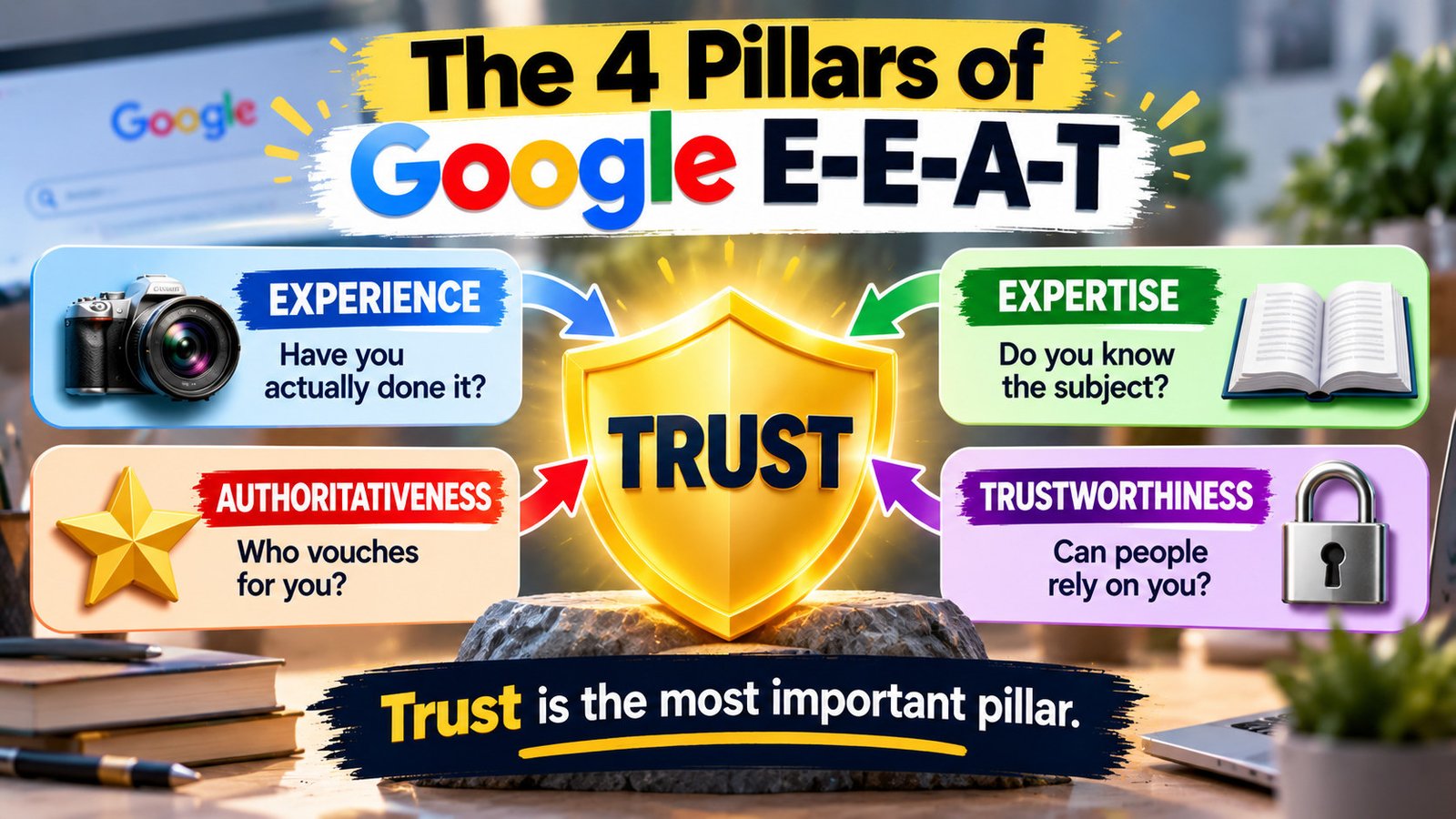
E-E-A-T stands for Experience, Expertise, Authoritativeness and Trustworthiness. It comes from the guidelines Google gives its human quality raters, the people who help Google test whether its search results are actually good. Google's own helpful content guidance is built around the same ideas.
Two things worth clearing up right away:
It Is Not a Single Score
There's no "E-E-A-T number" attached to your website. It's a way of describing what good, reliable content looks like, and Google's systems try to reward pages that show those qualities.
Trust Sits at the Center
Of the four, trust is the one the others feed into. A page can be experienced and expert, but if visitors can't tell who's behind it or whether it's safe to deal with them, the whole thing wobbles.
Why E-E-A-T Matters More for Indian Businesses
In India, a huge number of buyers still decide on trust before price. They check reviews, ask on WhatsApp, look for a real address and a real phone number, and quietly compare you with two other options. Your website is often the first place that trust gets tested, and Google is watching the same signals those buyers are.
Think about how many customers first hear of you through a forwarded WhatsApp message or a friend's recommendation, then quietly Google you before calling. That quick search is a background check. If what they find is thin, inconsistent or anonymous, the recommendation loses its weight before you've even spoken.
Crowded Local Markets
In most cities, dozens of businesses offer the same service. Proof is what separates you from the other twenty.
Cautious Buyers
Online fraud stories make people double-check. Visible, verifiable details calm that hesitation quickly.
Higher-Stakes Topics
Health, money, legal and education content is held to a higher bar because bad advice can genuinely hurt someone.
If you want the wider picture of how these signals fit into modern ranking, our breakdown of what Google rewards covers it in detail.
Experience: Show That You've Actually Done It
The extra "E" that Google added is the most human one. It asks a simple question: has the person behind this content actually lived it? A dentist writing about root canals, a contractor explaining waterproofing, a founder sharing what they learned after losing a client. First-hand detail is very hard to fake and very easy to recognise.
What First-Hand Proof Looks Like
- Real photos and videos from your own work, not stock images
- Specific stories: what went wrong, what you changed, what happened next
- Case studies with actual context, timelines and outcomes you can stand behind
- Details only someone who has done the work would know
A Quick Example
Picture two waterproofing contractors in Pune. Both have a page called "Terrace waterproofing". One lists generic benefits lifted from a supplier brochure. The other shows a real job: the leak, the site photos, what was used, how long it took and what the client said six months later. Same service, same city. Only one of them proves it has ever done the work, and that's the page people, and Google, are more likely to trust.
A short walkthrough video does more here than three paragraphs of claims, which is why we often pair strategy with explainer videos that let real work speak for itself.
Expertise: Credentials Without the Jargon
Expertise is about whether the author actually knows the subject. That doesn't always mean a degree. For a medical topic it does. For a recipe blog or a fitness routine, deep practical knowledge can be enough. What matters is that the level of expertise matches the topic.
Make the Author Visible
Put a real name, a short bio and relevant credentials on every important article and service page. If you want machines to understand it too, mark it up with Person schema so the author is connected to the content properly.
Keep the Content Accurate
An expert who publishes outdated or wrong information stops looking like one. Add a "last reviewed" date on important pages and actually update them.
Authoritativeness: Who Vouches for You?
Authority is reputation seen from the outside. It's not what you say about yourself, it's what others say about you: reviews, mentions, links, citations and recognition in your industry. You can't declare it, you can only earn it and make it easy to find.
- Genuine customer reviews on Google and other platforms you actually operate on
- Mentions or features in industry publications, local media or associations
- Links from relevant, respected websites, earned by being genuinely useful
- Consistent business details everywhere your name appears online
Consistency Counts More Than You'd Think
Write your business name, address and phone number the same way on your website, your profile, directories and social pages. Small mismatches, like "Pvt. Ltd." in one place and nothing in another, or an old number on a directory you forgot about, make it harder for search systems to be confident they're looking at one real business.
The simplest high-impact step is a complete, active Business Profile, with real photos, accurate timings and a habit of replying to every review, including the unhappy ones.
Trustworthiness: The Pillar Holding Everything Up
Trust is where small Indian businesses often lose ground without realising it. Visitors and search systems both look for signs that a real, accountable business stands behind the website.
The Basics That Quietly Build Trust
A working HTTPS site, a visible address and phone number, clear pricing or a clear way to get pricing, a proper privacy policy, refund or service terms, and easy ways to reach you. If you're GST-registered, displaying your GSTIN, which anyone can verify on gst.gov.in, is a strong, verifiable credibility signal.
Be Honest About What You Are
Don't claim awards you haven't won, reviews you didn't earn or clients who never hired you. Fake proof gets found out, and it damages trust far more than having less proof ever did.
Check Your Site Like a Stranger Would
Open your website on your phone and pretend you've never heard of your business. Try to answer three questions in under a minute: who is this, can I reach them, and would I be comfortable paying them? If any answer is a shrug, that's the first thing to fix.
A Trust-Signal Checklist for Indian Websites
Here's a practical list to run through. Most businesses tick fewer boxes than they expect.
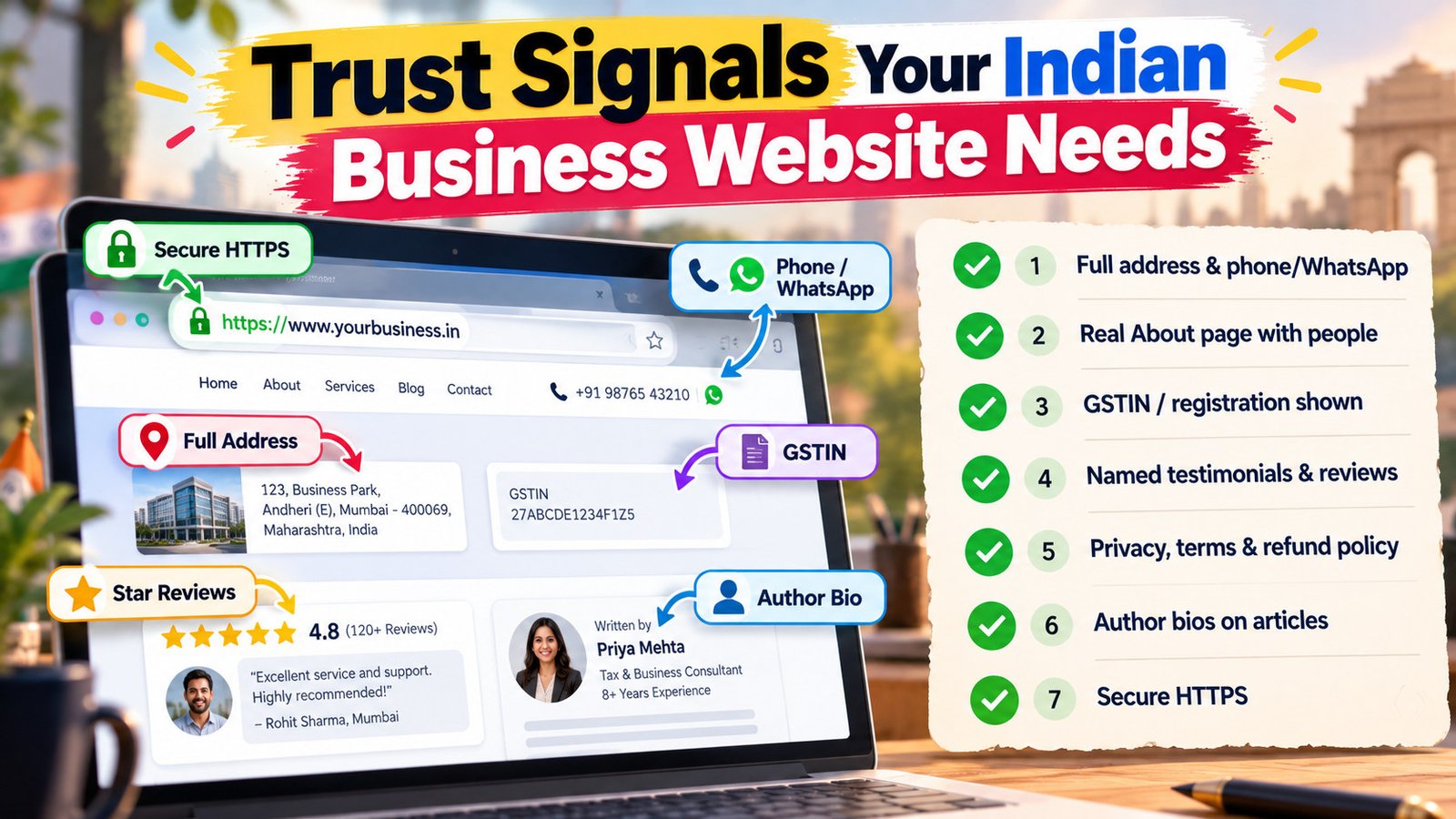
- Business name, full address and working phone or WhatsApp number on every key page
- An "About" page with real people, real photos and a real story
- GSTIN or company registration details shown where relevant
- Genuine testimonials with names, and links to verifiable reviews
- Clear privacy policy, terms and refund or cancellation information
- Named authors with short bios on articles and guides
- Secure HTTPS with no browser warnings
If you're a registered MSME, mentioning your Udyam registration alongside your other business details adds one more verifiable layer of legitimacy.
A Simple 5-Step E-E-A-T Audit You Can Run This Week
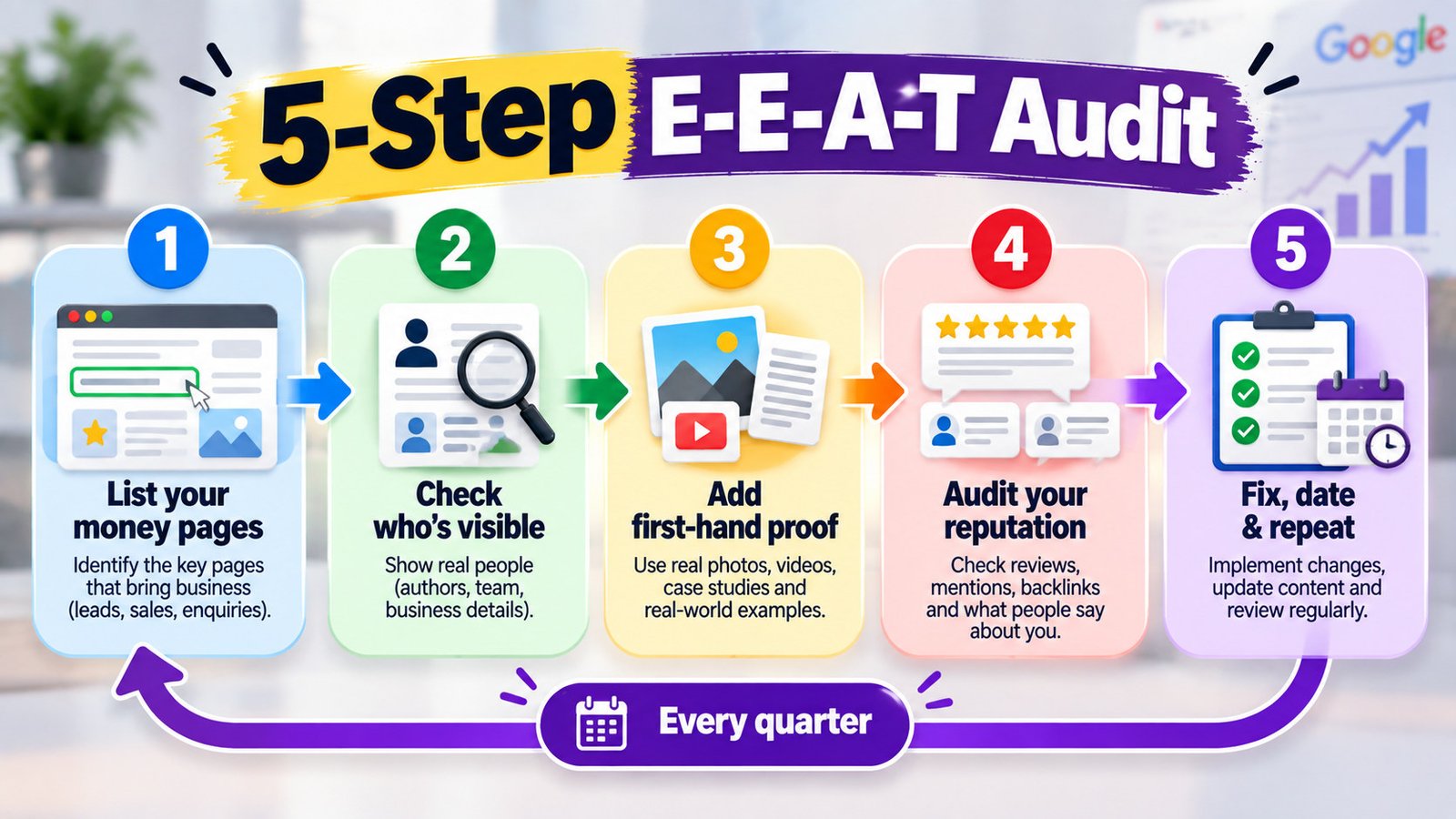
Step 1: List Your Money Pages
Pick the five pages that bring in leads or sales: your homepage, main service pages and best guides. Start there, not with everything.
Step 2: Check Who's Visible
Does each page show who wrote it, who's behind the business and how to reach them? If not, add it.
Step 3: Look for First-Hand Proof
Replace stock photos with real ones, add a real example or a short story from actual work.
Step 4: Audit Your Reputation
Search your business name. Read your reviews. Note what's missing, inconsistent or unanswered.
Step 5: Fix, Date and Repeat
Update inaccurate content, add "last reviewed" dates and set a quarterly reminder to run this again.
Once you've made changes, watch how those pages perform over the following weeks in Search Console, and improve the weakest one first.
After a quarter of steady work, you should see the basics settled: named authors on key pages, consistent business details, fresh reviews arriving and a few pages carrying real, first-hand proof. Rankings rarely jump overnight, but pages that answer real questions with real evidence become easier to rely on, for Google and for the people reading them.
Common E-E-A-T Mistakes We See Again and Again
- Anonymous blog posts with no author, no date and no bio
- Stock photos of "our team" who don't actually work there
- Fake or purchased reviews that read suspiciously alike
- An "About" page that talks about the industry instead of the people
- Outdated pages with old prices, old offers or broken contact details
- Publishing content on topics outside anything the business genuinely knows
Many of these are the same warning signs behind the website red flags that quietly cost businesses customers long before they show up in rankings.
E-E-A-T in the Age of AI-Generated Content
AI can draft a page in minutes, which means the internet is filling up with content that sounds fine and says nothing. Google isn't against AI-assisted content as such. What it rewards is content that's genuinely helpful, and the thing an AI tool can't supply on its own is your real experience.
Use AI for structure and first drafts if it helps, then add what only you can: the client story, the mistake you learned from, the number you actually saw. That human layer is precisely what E-E-A-T is looking for. We share more practical guides like this on our blog.
Extra Care for "Your Money or Your Life" Topics
Topics that can affect someone's health, finances, safety or legal position are held to a higher standard. If you're a clinic, a CA firm, a legal practice, a coaching institute or a financial advisor, your content should be written or reviewed by a qualified person, cite reliable sources and be updated when rules or facts change.
In practice that looks like a clinic page reviewed by a named doctor, a CA firm's tax explainer that shows the date it was last checked, or a coaching institute that shares faculty credentials and honest results instead of unverifiable "100% success" claims. Big promises without proof are the fastest way to lose the trust of both readers and search systems.
How MGA Brand Buzz Can Help
| What You Need | How We Help | Link |
|---|---|---|
| Content and authority that Google can trust | Technical fixes, expert-led content plans and structured data that surface your real credentials | SEO |
| A website that visibly builds trust | About pages, author bios, trust badges and a clean, secure structure that supports credibility | Web Development |
| Social proof that reinforces your reputation | Consistent, honest content that shows real work, real people and real results | Social Media Marketing |
| An E-E-A-T plan for a sensitive or niche industry | Custom strategy for health, finance, legal and other high-trust sectors | Custom Solutions |
The Bottom Line
E-E-A-T isn't a trick or a checklist to game. It's a description of what a genuinely trustworthy business looks like online. Show your experience, make your expertise visible, earn your reputation and be transparent about who you are. Do that consistently and the rankings tend to follow. If you only do one thing today, add a real name, a real photo and a short bio to your most important page. It takes ten minutes and it changes how that page reads. Take a look at our recent work to see how we put this into practice for real brands.
Frequently Asked Questions
What does E-E-A-T stand for?
Experience, Expertise, Authoritativeness and Trustworthiness. It's the framework Google's quality raters use to judge how reliable and helpful a page and its creator are.
Is E-E-A-T a direct Google ranking factor?
No. There's no single E-E-A-T score. It describes qualities Google's systems try to reward, so improving them tends to help rankings indirectly.
Which part of E-E-A-T matters most?
Trust. Google's guidelines treat it as the most important element, because experience, expertise and authority all support whether a page can be relied on.
How can a small Indian business show E-E-A-T?
Show real people and real work, publish named author bios, keep your address and contact details visible, collect genuine reviews and display verifiable business details like GSTIN where relevant.
Do I need credentials to demonstrate expertise?
It depends on the topic. Health, legal and financial content needs recognised qualifications. For many other subjects, demonstrable hands-on knowledge is enough.
Does E-E-A-T apply to AI-written content?
Yes. Google judges content by how helpful and trustworthy it is, not by how it was produced. AI drafts still need genuine experience, accuracy and human review.
How long does it take to improve E-E-A-T?
Quick fixes like author bios and contact details can be done in days. Reputation and authority build over months through consistent, genuine work.
Can fake reviews improve my E-E-A-T?
No. Fake or purchased reviews are risky and can damage trust with both customers and search engines. Earn reviews from real customers instead.
Want an honest read on how your website scores on trust and credibility right now? Get in touch and we'll walk you through what to fix first.