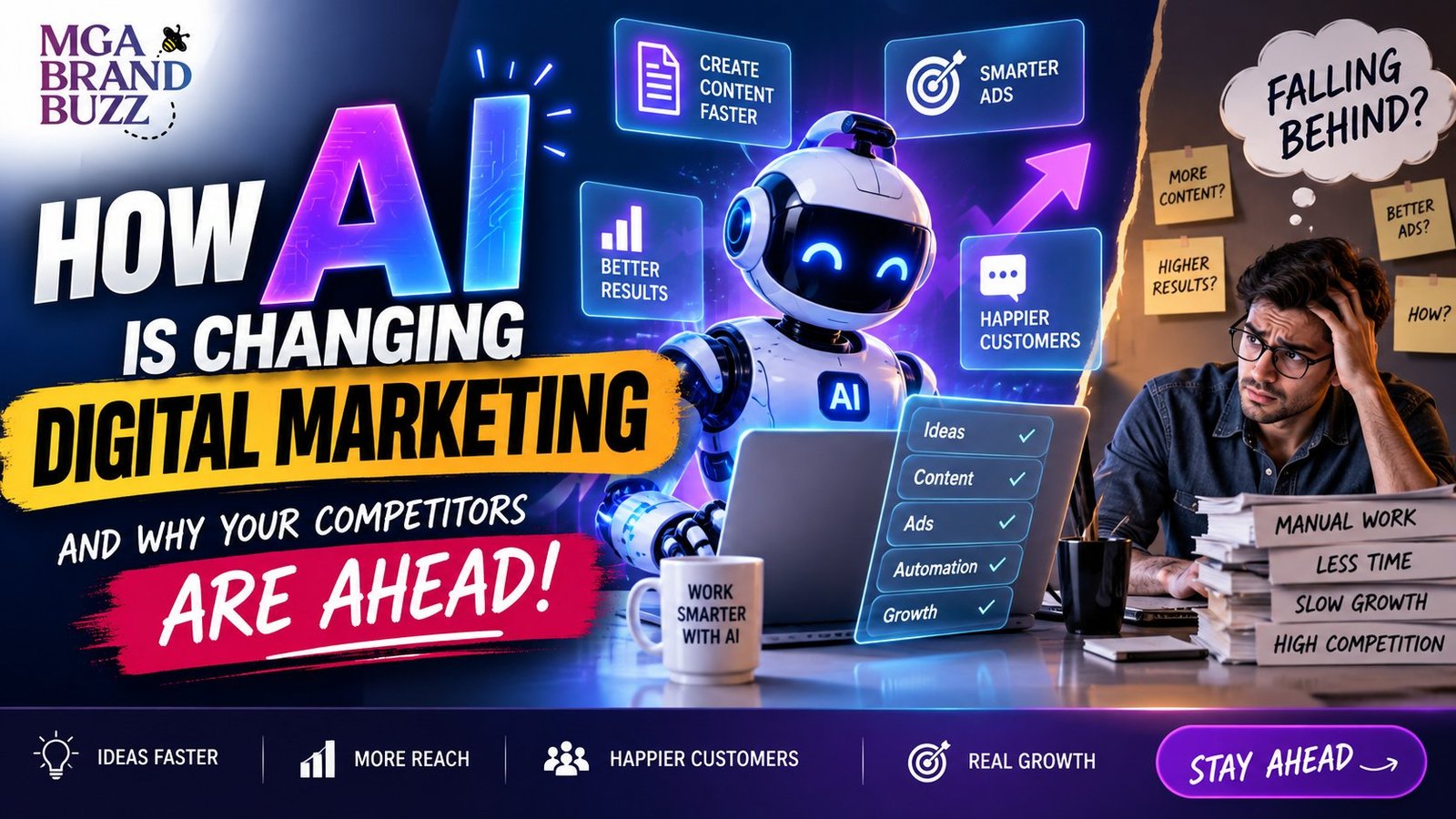
Somewhere in your industry, right now, a competitor with a smaller team than yours is publishing more content, running tighter ad campaigns, and replying to customer messages faster than you ever could manually. They're not working harder. They just built AI into the parts of marketing that used to eat their whole week.
The gap forming right now isn't between big budgets and small ones. It's between businesses using AI to remove grunt work, and businesses still doing that grunt work by hand.
This isn't a hype piece about robots replacing marketers. It's a straight, practical look at what AI is genuinely changing in digital marketing in 2026, where it's overhyped, where human judgment still wins outright, and exactly how to close the gap without losing what makes your brand sound like you.
The Real Reason Your Competitors Feel Ahead Right Now
It rarely comes down to a single secret tool. It comes down to volume and speed compounding quietly over months. A competitor who can draft, test, and publish three content variations in the time it used to take to produce one isn't necessarily more talented. They've just removed the bottleneck that used to slow everyone down equally.
Picture two businesses selling nearly the same service. One writes a single Instagram caption on a Tuesday, agonizes over it for twenty minutes, posts it, and moves on. The other drafts four versions of the same caption in the time it takes to make a cup of chai, glances at what's worked in past posts, picks the one that actually sounds like them, and posts that instead. Multiply that difference by fifty posts a quarter and the gap stops looking like luck.
That compounding effect is easy to underestimate from the outside. A business that looks like it's "everywhere" this quarter usually isn't spending more, they're simply not re-typing the same first draft five times or waiting three days for a single ad variant to get built. It's the same principle we lean on across our work for clients, remove the repetition, keep the judgment.
None of this works without checking what actually landed. The same discipline behind structured testing applies here too: draft several versions, but only keep doing what the data says is actually working.
Teams that adopt this early often see meaningfully faster turnaround on routine content, simply because the first draft stops being the bottleneck.
What "AI in Marketing" Actually Means in 2026, Not the Hype Version
Strip away the buzzwords and AI's real, working role in marketing right now falls into a few concrete categories.
Content Drafting and Variation
Generating first drafts of captions, ad copy, and outlines, then having a human edit, fact-check, and inject actual brand voice and experience before anything goes live. The same logic applies to video editing, where AI can rough-cut footage but a real editor still decides what makes the final story land.
Ad Targeting and Optimization
Platforms like Meta and Google now lean heavily on machine learning to test audience segments and creative combinations far faster than a human could manually A/B test one variable at a time. Google Ads itself now defaults new campaigns toward automated bidding rather than fully manual controls.
Customer-Facing Automation
Chatbots and automated reply systems that handle the repetitive first layer of customer questions, freeing actual humans for the conversations that genuinely need judgment.
None of this is science fiction. It's mostly unglamorous automation of tasks that used to consume entire afternoons, quietly redirected toward higher-value work.
Where AI Is Already Quietly Running Inside Your Competitors' Marketing
Content Velocity
Drafting multiple caption or headline variations in minutes instead of hours, then picking the strongest one rather than settling for the only one.
Smarter Ad Spend
Machine-optimized targeting shifting budget toward what's actually converting in near real time, instead of waiting for a weekly manual review.
Personalization at Scale
Tailoring email or on-site messaging to different customer segments without manually building a dozen separate campaigns from scratch.
Faster Analysis
Summarizing performance data into plain, actionable takeaways instead of a person manually cross-referencing spreadsheets every Monday morning.
Teams doing this well aren't necessarily producing better ideas than you. They're just testing more of their ideas before picking a winner, which is a fundamentally different game than publishing a single guess and hoping. The "Faster Analysis" piece alone is a bigger deal than it sounds. A dashboard like Google Analytics already has the raw numbers; AI just removes the hour someone used to spend translating them into a plain sentence a founder can actually act on.
The Real Risk Isn't AI, It's Sounding Like Everyone Else
Here's the part that gets skipped in most "AI marketing" advice. When every business uses the same tool with the same default settings, the output starts to sound identical. Generic AI-drafted captions, the same three ad hooks, the same overly formal chatbot tone, across a hundred unrelated brands. Scroll any crowded niche on Instagram for ten minutes and you'll start recognizing the same sentence rhythm popping up on five different accounts, because they all typed the same prompt into the same tool and hit publish without changing much.
- Publishing AI-drafted content without ever rewriting it in your own actual voice
- Letting a chatbot answer questions it clearly doesn't have real information for, damaging trust instead of saving time
- Using AI-generated stats or claims without checking whether they're even accurate
- Treating AI output as the finished product instead of a fast first draft
- Losing the specific, personal detail that made your brand's content worth reading in the first place
A Practical, Non-Overwhelming Way to Start
You don't need to overhaul your entire stack this month. A staged approach works far better than trying everything at once: change one thing, measure it honestly, then move on.
Step 1: Pick One Repetitive Task
Caption drafting, replying to common customer questions, or summarizing weekly performance data are all good starting points that eat real hours without needing much judgment.
Step 2: Automate the Draft, Not the Decision
Let AI produce the first version. A human should still be the one deciding what actually goes live, especially anything customer-facing.
Step 3: Measure the Time Actually Saved
Track hours saved on that one task honestly before expanding further. Vague enthusiasm isn't a strategy; a measurable hour count is. Even a simple weekly note, ten minutes saved here, thirty there, adds up to a real number within a month.
Step 4: Expand One Layer at a Time
Once the first task is genuinely working, move to the next bottleneck. Teams that try to automate everything simultaneously usually end up trusting none of it, and quietly slide back to doing everything manually within a few weeks.
AI Tools vs the Old-School Manual Way: What Actually Changes
| Task | Manual Way | AI-Assisted Way |
|---|---|---|
| First draft of ad copy | One version, written once, used as-is | Several variations drafted quickly, best one selected and edited |
| Answering common customer questions | Every message answered manually, even repeat questions | Repeat questions handled instantly, human steps in for anything nuanced |
| Reviewing campaign performance | Manually built spreadsheets each week | Plain-language summaries generated in minutes, freeing time for actual strategy |
| Testing new audience segments | One segment tested at a time, slowly | Multiple segments tested in parallel by the platform itself |
None of this replaces the fundamentals. A faster ad workflow still needs a page worth sending that traffic to, which is exactly what Google rewards in 2026 covers in more depth.
Where Human Judgment Still Wins, Every Single Time
Brand Voice and Genuine Personality
AI can imitate a tone once you feed it examples, but the specific, slightly odd, memorable choices that make a brand feel like a real personality still come from an actual person willing to take a stance.
Strategy and Prioritization
Deciding what to actually focus on this quarter, based on real business goals and genuine market context, isn't something a tool can responsibly decide on its own.
Trust, Ethics, and Judgment Calls
Knowing when a customer needs a real human response, or when a claim needs fact-checking before it goes anywhere public, remains squarely a human responsibility, not an automated one. This is exactly why an AI-powered chatbot on your website still needs a visible, easy escape hatch to a real person.
Common Mistakes Businesses Make Adopting AI Marketing
- Publishing the very first AI draft without any human editing pass at all
- Automating customer replies without a clear, visible handoff to a real person when needed
- Chasing every new AI tool that launches instead of mastering one that already fits an actual workflow
- Assuming AI adoption alone fixes a marketing strategy that was already unclear to begin with
- Ignoring the data and privacy implications of the tools being connected to customer information
Most of these mistakes come from treating AI as a replacement for strategy rather than an accelerant for a strategy that already exists. The tool speeds up execution. It doesn't decide what's worth executing in the first place.
How to Tell If a New AI Tool Is Actually Worth Adopting
New AI tools launch weekly, and the temptation to chase every single one is real. Most businesses don't need more tools. They need a simple filter for deciding which ones deserve actual attention.
- Does it solve a specific, named bottleneck, or a vague, general problem?
- Can someone on the team actually learn it in under a day without a dedicated training course?
- Does it fit into an existing workflow, or does it require rebuilding everything around it?
- Is there a clear, honest way to measure whether it's actually saving time after two weeks of real use?
- Does the output still need a human review step before anything reaches a customer?
If a tool fails more than one of these questions, it's very likely to end up abandoned within a month, another subscription quietly draining budget while nobody actually opens it. The businesses that get real value from AI tend to run fewer tools, chosen deliberately, rather than a scattered collection tried once and forgotten.
Where AI Still Gets It Wrong, and Why That Matters
It's worth being honest about the failure modes too, since most AI marketing advice glosses right over them. Language models can state incorrect facts with total confidence. Automated ad targeting can quietly drift toward audiences that convert cheaply but don't match the actual brand. Chatbots can frustrate a customer for several exchanges before finally admitting they can't help.
None of these are reasons to avoid AI entirely. They're reasons to keep a human genuinely in the loop rather than treating automation as fully hands-off. The businesses getting burned right now aren't the ones using AI, they're the ones who stopped checking its work.
What This Means If You're a Small Business, Not a Big Brand
This shift is arguably more useful for smaller teams than large ones. A five-person business using AI to remove repetitive drafting and reporting work can genuinely compete for attention against a much larger competitor's marketing department, something that was far harder to pull off before these tools existed. Industry surveys such as HubSpot's State of Marketing report have tracked this shift toward AI-assisted workflows across businesses of every size for a few years running.
The advantage isn't unlimited, and it isn't automatic either. It shows up specifically for the businesses willing to test small, measure honestly, and keep an actual human reviewing anything before it reaches a real customer, and it compounds fastest for teams that also fix the SEO foundation underneath all that faster content. Small teams doing both well have consistently punched well above their size in the last two years.
How MGA Brand Buzz Can Help
Adopting AI well is less about the tool and more about the strategy wrapped around it. Here's where our team typically plugs in.
| What You Need | How We Help | Link |
|---|---|---|
| AI-assisted content across social platforms, without losing your brand voice | Strategy, editing, and a real human review layer on every AI-assisted post | Social Media Marketing |
| On-brand visuals and creative assets that don't look like generic AI output | Design direction and polish on every asset before it ships | Graphic Design |
| A custom AI workflow that fits your specific business, not a generic template | A tailored setup built around your actual bottlenecks and goals | Custom Solutions |
| A full, honest look at where AI could realistically help your marketing | A practical audit and roadmap across your entire digital presence | All Services |
The Bottom Line
Closing that gap doesn't require replacing your team or your judgment with a tool. It requires being honest about which parts of your marketing are pure repetition, worth automating, and which parts genuinely need a human paying real attention. Get that split right, and AI stops being a buzzword and starts being time back in your week.
If you want an honest look at where AI could actually help your specific business, rather than a generic pitch, get in touch.
Frequently Asked Questions
Is AI actually replacing digital marketers in 2026?
No. AI is automating repetitive tasks like first drafts, ad testing, and basic customer replies, but strategy, brand voice, and judgment calls still require a real person. Businesses combining both are the ones pulling ahead.
What tasks in marketing are actually worth automating with AI right now?
Repetitive, high-volume tasks with low judgment requirements work best: first-draft content, answering common customer questions, and summarizing performance data. Anything requiring real judgment should stay human-reviewed.
Will using AI make my content sound generic?
It can, if the output is published without editing. Content stays authentic when AI is used for the first draft only, with a real person rewriting it to match actual brand voice before it goes live.
Do small businesses actually benefit from AI marketing tools?
Often more than larger businesses, since removing repetitive work frees up limited time for a small team to compete with much larger marketing departments on speed and consistency.
How do I start using AI in my marketing without it feeling overwhelming?
Pick one repetitive task, automate only the draft stage while keeping a human decision-maker, measure the actual time saved, and only then expand to a second task.
Is it risky to let AI handle customer service messages?
It's risky only without a clear handoff. AI works well for repeat, simple questions, but there should always be a visible, easy way for a customer to reach a real person for anything nuanced.
Does AI in marketing require a big budget to get started?
No. Many of the most useful starting points, like AI-assisted drafting and basic chat automation, are available at low or no cost. The bigger investment is usually strategy and human oversight, not the tool itself.