
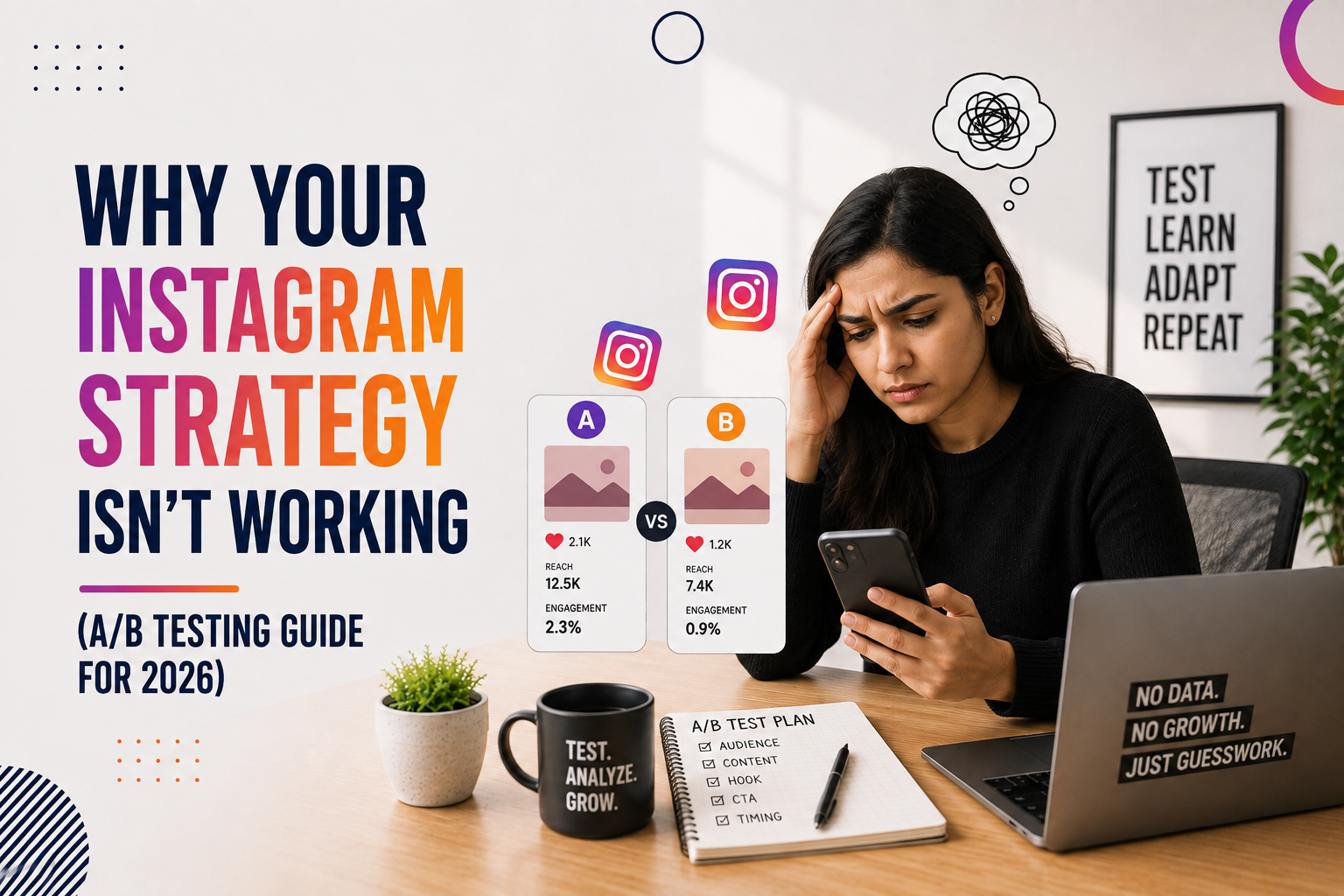
You've posted consistently for months. The captions are thoughtful, the visuals look clean, and you're technically "doing everything right." And yet the reach barely moves, the saves are thin, and the DMs asking about your product are nowhere to be found.
If that sounds familiar, here's the honest answer nobody tells you: your Instagram strategy isn't broken because you're bad at content. It's broken because you've never actually tested anything. You've been guessing, publishing, hoping, and repeating — and calling that a strategy.
A real strategy involves testing. Not the vague kind of testing where you post two different things a month apart and eyeball the difference. Proper Instagram A/B testing, done in a structured, repeatable way. This guide walks through exactly why your Instagram strategy isn't working and how Instagram A/B testing in 2026 fixes it, one variable at a time.
Why Is My Instagram Strategy Not Working?
This is the question we hear more than any other, and it almost always comes from businesses that are working hard, not businesses that are working badly. The effort is there. The system isn't.
Here's what's usually actually happening:
- Every post is a fresh guess instead of a build on what already worked
- Success and failure are being judged by gut feeling, not by data
- One post performing badly gets blamed on "the algorithm" instead of being investigated
- Content decisions are copied from competitors instead of tested on your own audience
- Nobody is tracking which specific variable — hook, format, caption length, posting time — actually moved the needle
Without testing, every week resets to zero. You never actually get smarter about your own audience, because you're never isolating what worked from what didn't.
What Instagram A/B Testing Actually Means
On a website, A/B testing is simple: show version A to half your visitors, version B to the other half, and measure which converts better. Instagram doesn't let you split traffic that cleanly, so Instagram A/B testing works a little differently — but the core principle is identical: change one variable at a time, keep everything else constant, and let the data tell you what actually works for your specific audience.
Instead of splitting an audience in half at the same moment, Instagram A/B testing typically compares:
- Two similar posts published under matched conditions (similar day, similar time, similar topic) with one deliberate difference
- Instagram's built-in split testing tools inside Ads Manager for paid content
- Reels with identical content but different hooks, covers, or captions, published a few days apart
- Story sequences with different CTA placements, tracked through link clicks or sticker taps
The goal is never "which post got more likes." The goal is isolating the one variable that actually changed the outcome, so you can repeat it deliberately instead of accidentally.
What You Should Actually Be Testing in 2026
Not every variable is worth testing. Some move the needle significantly; others barely matter. Here's where to focus.
The First 3 Seconds
The opening frame and hook line of a Reel determine whether someone stays or scrolls. Test different opening lines and visuals on otherwise identical content.
Format
Reels, carousels, and single images all get distributed differently. Test the same message across formats to see what your specific audience actually engages with.
Caption Length
Short, punchy captions versus longer storytelling captions can perform completely differently depending on your niche and audience intent.
Posting Time
Generic "best time to post" advice ignores your specific audience's habits. Test two time windows over several weeks to find your real peak.
Call-to-Action Style
"Comment below" versus "DM me the word GROWTH" versus "Link in bio" can produce very different response rates. Test explicit CTAs against soft ones.
Cover Thumbnail
For Reels and carousels, the static cover image often decides whether someone taps in from your grid or a hashtag search. Small design changes here compound fast.
Instagram A/B Testing Guide 2026: A Step-by-Step Framework
Here's the exact structure we use to run a proper Instagram A/B test without needing an enterprise marketing budget.
Step 1: Pick One Variable Only
Testing hook, format, and caption length all at once tells you nothing, because you can't isolate what actually caused the result. Choose exactly one variable per test cycle.
Step 2: Keep Everything Else Identical
Same topic, same general quality level, same rough posting window, same call to action structure. The only thing that should differ is the one variable you're testing.
Step 3: Give Each Version a Fair Sample Size
Judging a test after a few hundred views is misleading. Let each version run long enough to reach a comparable, meaningful audience size before drawing conclusions — for most small accounts, that means waiting several days, not a few hours.
Step 4: Track the Metric That Matches Your Actual Goal
If your goal is awareness, track reach and shares. If it's community, track comments and saves. If it's sales, track profile visits, link clicks, and DMs. Don't judge a sales-focused test by like count.
Step 5: Document the Result Before You Forget It
Keep a simple running log: what you tested, what won, and by how much. Over a few months this log becomes your own personal playbook for what actually works with your audience — something generic Instagram advice can never give you.
Step 6: Apply the Winner, Then Test the Next Variable
Once you know your winning hook style, lock it in as your new baseline and move to testing the next variable, such as format or posting time. This is how a strategy compounds instead of resetting every week.
Metrics That Actually Matter (And the Ones That Don't)
One of the biggest reasons Instagram strategies quietly fail is that businesses are optimizing for the wrong number.
| Vanity Metric | What It Actually Tells You |
|---|---|
| Likes | Almost nothing about buying intent or content quality at scale |
| Follower count | Doesn't reflect how many people actually see or act on your content |
| Total views | Includes people who scrolled past in under a second |
What to track instead:
- Average watch time and retention rate on Reels
- Saves, which signal genuine value someone wants to revisit
- Shares to DMs and Stories, which signal content worth spreading
- Profile visits following a post, which signal curiosity about your brand
- Link clicks or DM replies, which signal actual business intent
These are the numbers that should decide which version of your A/B test wins — not which post simply got more hearts.
A Simple Example of How This Plays Out
Picture two versions of the same Reel about a skincare routine. Version A opens with a calm, direct line: "Here's my 3-step night routine." Version B opens with a pattern interrupt: "I used to think expensive skincare was the answer. I was wrong." Same product, same information, same length, same posting day.
Version A gets steady but average retention. Version B holds viewers significantly longer past the three-second mark and drives noticeably more saves. That single data point is worth more than a month of guessing, because now you know something concrete about your specific audience: they respond to a personal, contrarian hook more than a straightforward instructional one. You didn't need a huge budget to learn this. You needed one controlled test.
Common Mistakes That Ruin Instagram A/B Tests
- Changing more than one variable at once, making results impossible to interpret
- Comparing posts from wildly different topics or seasons
- Judging results after only a few hours instead of letting the post reach a stable audience
- Ignoring outside factors like a trending audio or a platform-wide reach dip that day
- Never writing results down, so lessons get forgotten and mistakes get repeated
- Testing on an account with too little baseline activity to produce meaningful signal
A/B testing only works when it's disciplined. A single messy test that changes five things at once is not a test — it's just another guess with extra steps.
Tools You Can Actually Use to Run These Tests
You don't need an enterprise martech stack to run a proper Instagram A/B testing guide 2026-style workflow. Most of what you need is already available for free or close to it.
- Instagram's native Insights tab on each Reel and post, which shows retention, reach, and saves without any extra tools
- Meta Ads Manager's built-in A/B testing feature, useful once you start putting budget behind top-performing organic content
- A simple shared spreadsheet logging date, variable tested, result, and winner — genuinely the most important "tool" in this entire process
- Scheduling tools that let you plan matched posting windows in advance, so your test conditions stay consistent
- Link-in-bio tools with click tracking, useful for testing CTA phrasing when the goal is website traffic
The tool matters far less than the discipline of actually recording results. A blank spreadsheet that gets filled in every week will outperform an expensive analytics dashboard nobody checks.
Why This Matters More in 2026 Than Ever Before
Instagram's distribution logic keeps shifting toward genuine engagement signals like watch time, saves, and shares, and away from raw follower count. Accounts that are still optimizing purely for likes and posting frequency are optimizing for a version of the platform that no longer exists.
The accounts pulling ahead in 2026 are the ones treating their content like a system that gets refined, not a stream of content that gets produced. Instagram A/B testing is how that refinement actually happens, deliberately, instead of by accident.
If building and running this kind of testing system feels like more than your team has bandwidth for, our Social Media Marketing team builds exactly this kind of structured, tested content strategy for brands who are done guessing. And when a test tells you video hooks are your strongest format, our Video Editing team can produce that content at the quality your winning variable deserves.
Frequently Asked Questions
Why is my Instagram strategy not working even though I post daily?
Posting frequency alone doesn't fix a strategy that's never been tested. Daily posting without isolating what actually works just produces more untested guesses, faster, rather than genuine improvement.
What is Instagram A/B testing?
Instagram A/B testing means comparing two versions of similar content, changing only one variable such as the hook, format, or posting time, to see which one performs better on your specific audience.
How long should an Instagram A/B test run before I check results?
Most small to mid-sized accounts should wait several days per version to reach a stable, comparable audience size before drawing conclusions, rather than judging results after just a few hours.
What should I test first on Instagram?
Start with the opening hook of your Reels. It has the single biggest impact on retention and is one of the easiest variables to isolate and test cleanly.
Do I need a large following to run A/B tests on Instagram?
No. Even smaller accounts can run meaningful tests by comparing performance over a longer time window and focusing on retention and saves rather than raw reach numbers.
The Bottom Line
Every untested post is a guess. Every tested post is a lesson. Run enough disciplined lessons and you stop guessing entirely, because you're working from a growing, personal playbook of what your exact audience actually responds to.
Start with one variable this week. Pick your Reel hooks, run two versions under matched conditions, track saves and retention instead of likes, and write down what you learn. That single habit, repeated consistently, is the real difference between an Instagram strategy that works and one that just keeps producing content into the void.
Ready to turn your social media into a tested, repeatable system instead of a guessing game? Explore our Social Media Marketing services or get in touch with our team today.