
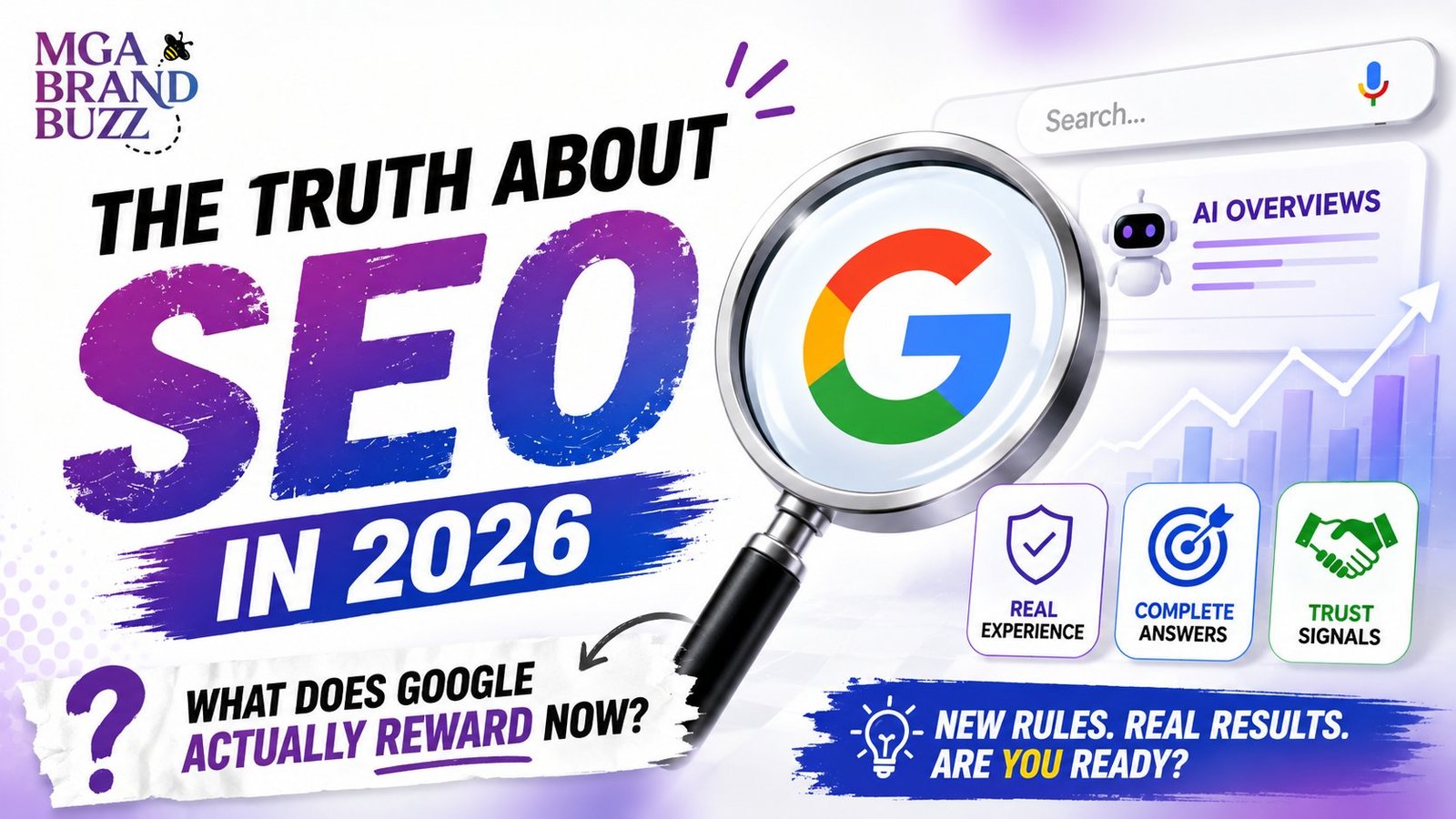
Open any "SEO checklist" published before 2023 and you'll find the same tired advice: stuff your keyword five times, get a hundred backlinks from anywhere that'll take you, write to a word count target, and wait. Follow that playbook in 2026 and you won't just fail to rank. You'll actively make Google trust your site less.
SEO didn't die, despite what half the internet keeps announcing every time Google ships an update. It changed shape completely, and most business owners are still optimizing for a search engine that stopped existing years ago. This isn't another listicle of "50 SEO tips." It's a straight answer to the question we get asked constantly: what does Google actually reward right now, today, in 2026?
The Old SEO Playbook Is Actively Working Against You
Here's the uncomfortable part nobody likes to say out loud. A lot of the tactics that used to work are now liabilities. Google's core ranking system has spent the last few update cycles getting significantly better at recognizing content built to game rankings versus content built to genuinely help someone.
Some of the old habits still floating around client briefs and outdated blog posts:
- Repeating the exact keyword phrase unnaturally throughout a page, hoping density equals relevance
- Publishing thin, templated pages just to increase the number of indexed URLs on a site
- Chasing backlink volume from low-quality directories instead of a handful of genuinely relevant, authoritative sites
- Writing to hit a word count target rather than to actually finish answering the question
- Treating meta tags as the whole strategy instead of one small piece of it
What Google Actually Rewards in 2026
Strip away the jargon and Google's ranking systems in 2026 are optimizing for one core question, repeated across every page they crawl: does this genuinely help the person who searched, better than the alternatives already ranking?
Real Experience, Not Just Expertise
Content written by someone who has actually done the thing, not just researched it, consistently outperforms generic, research-only content covering the same topic.
Complete Answers, Not Padded Ones
A page that fully answers a question in 600 focused words will outrank a 2,000-word page that circles the topic without ever landing on a direct answer.
Genuine Trust Signals
Visible authorship, real contact information, transparent business details, and consistent accuracy across a site all quietly feed into how much Google is willing to trust it.
Technical Health
Fast load times, clean mobile rendering, and a crawlable site structure remain a baseline requirement, not a bonus, for everything else to even get a fair chance.
E-E-A-T Isn't a Buzzword Anymore, It's Baked Into the Algorithm
Experience, Expertise, Authoritativeness, and Trustworthiness used to feel like a soft, qualitative framework mostly discussed in Google's rater guidelines, not something that showed up directly in rankings. That gap has closed significantly. The systems that assess helpfulness now weigh these signals as part of every core update, not as a separate, occasional classifier.
In practice, this means a few very concrete things for any business publishing content:
- Every important page should make it obvious who wrote it and why they're qualified to
- Original insight, a specific case, a real number, a genuine opinion, consistently beats generic, safe restatements of what every competitor already says
- A site with a real physical presence, real contact details, and a consistent track record earns more trust than an anonymous domain with none of that
- Content that gets quietly updated and kept accurate over time signals ongoing care, not a one-time publish and forget
If your content still reads like it was written to satisfy a content calendar rather than to genuinely help someone, that's the single biggest lever left to pull, and it costs nothing but time and honesty.
AI Overviews and AI Mode Changed the Game, Not the Fundamentals
A huge share of searches in 2026 now get partially or fully answered before a user ever scrolls to a traditional blue link. That's a genuinely disruptive shift, and it's understandably made a lot of business owners nervous about whether SEO even matters anymore.
Here's the part that gets missed constantly: AI Overviews and AI Mode are built on the same underlying ranking and quality systems as classic search. They're not a separate discipline with separate rules.
The content that gets pulled into an AI-generated answer is, overwhelmingly, content that was already well-structured, clearly written, and genuinely authoritative on the topic. Getting cited by an AI answer isn't a different game from ranking well. It's the same game, with an extra reward for being clear and quotable.
What actually helps here:
- Answering the core question directly near the top of the page, before diving into supporting detail
- Using clear heading hierarchy so both readers and machines can follow the structure of the page
- Including specific facts, numbers, and statements that are easy to lift and cite accurately
- Backing claims with structured data where relevant, which helps systems parse and attribute content correctly
What Matters Far Less Than It Used To
Just as important as knowing what to focus on is knowing what to stop obsessing over.
| Old Obsession | 2026 Reality |
|---|---|
| Exact keyword density | Google understands semantic meaning and synonyms; natural language wins |
| Total backlink count | A handful of genuinely relevant, authoritative links outweighs hundreds of low-quality ones |
| Hitting a strict word count | Google has confirmed word count isn't a direct ranking factor; coverage depth is what matters |
| Basic readability scores | Useful for your own audience, but not used directly by Google for ranking |
| Publishing frequency alone | A smaller number of genuinely helpful pages beats a high volume of thin ones |
None of these are actively harmful in moderation. They've simply stopped being the lever that moves rankings, and treating them as the whole strategy is how a lot of time and budget quietly gets wasted every year.
The Technical Baseline Still Has to Be Right
Great content on a technically broken site still won't rank. This part of SEO hasn't changed nearly as much as the content side has, it's just less exciting to talk about.
Crawlability and Indexing
Search engines need to actually be able to find, crawl, and index your pages without hitting broken links, redirect chains, or blocked resources getting in the way.
Core Web Vitals
Load speed, visual stability, and responsiveness directly affect both user experience and how Google evaluates page quality, especially on mobile.
Clean, Consistent URL Structure
A logical, consistent site structure with proper canonical tags prevents duplicate content confusion and helps search engines understand what each page is really about.
Structured Data
Schema markup doesn't directly boost rankings on its own, but it helps search engines and AI systems parse your content correctly, which matters more than ever for citation and rich results.
Mobile Experience
With the overwhelming majority of searches happening on mobile, a site that isn't genuinely built mobile-first is quietly losing both rankings and real customers every day.
If any of this sounds like it's been neglected on your site, it's worth a proper technical audit before investing further in content. Our SEO services start exactly there, fixing the technical foundation before building the content strategy on top of it.
SEO Myths Still Circulating in 2026 That Need to Die
Some outdated ideas simply won't go away, mostly because they were repeated so often for so many years that they now sound like common sense, even though they haven't been true for a while.
"You need thousands of words to rank"
Length has never been the point. Coverage has. A focused page that fully answers a specific question can outrank a padded, generic page many times its length. Write until the question is genuinely answered, then stop.
"Backlinks are all that really matter"
Links still carry weight, but the quality bar has risen sharply. A single link from a genuinely relevant, respected source in your industry is worth more than fifty links from unrelated directories that exist purely to sell links.
"Keyword stuffing gets you found faster"
Google's language understanding has advanced far enough that unnatural repetition doesn't help relevance signals anymore, it just makes content harder and less pleasant to read, which hurts the engagement signals that actually do matter.
"SEO is a one-time project you finish"
Search behavior, competitor content, and algorithm priorities all shift continuously. Sites that treat SEO as a one-off task tend to plateau and slowly decline, while sites that treat it as ongoing maintenance keep compounding.
"AI-written content never ranks"
The real dividing line isn't whether AI assisted the writing process. It's whether the final content demonstrates genuine expertise, original insight, and real human oversight, versus generic, unedited output with no added value. Google's own guidance is clear on this distinction.
Old SEO vs New SEO: A Side-by-Side Look
Here's what the same piece of work looks like under the old playbook versus the current one.
The Old Approach
Pick a keyword, repeat it throughout a 2,000-word article regardless of whether the topic needs that much space, buy a batch of backlinks from a marketplace, publish, and move on to the next page without revisiting it.
The 2026 Approach
Answer the real question a person is searching for, as completely as the topic actually requires, cite genuine experience or data, earn a small number of relevant links naturally through genuinely useful content, and revisit the page periodically to keep it accurate and current.
Both approaches take effort. Only one of them keeps working after the next core update ships, because it was never dependent on exploiting a gap in the algorithm in the first place.
A Simple Way to Think About It Going Forward
Every time you're deciding what to publish or fix next, ask one honest question: if Google didn't exist, would a real person still find this genuinely useful? If the answer is yes, you're very likely on the right track, regardless of which specific update rolls out next. If the answer is no, no amount of technical tweaking will make up for the gap.
This is genuinely good news, not bad news. It means SEO in 2026 rewards the same instinct that builds a good business in the first place: actually being useful to the people you're trying to reach, consistently, over time.
A 30-Minute Self-Audit You Can Actually Run Today
You don't need expensive software to get a real read on where your site stands. Spend thirty focused minutes on this and you'll know exactly where to start.
- Open your three most important pages on your phone. Does everything load fast and look genuinely usable, or does something feel clunky and dated?
- Read your top blog post out loud. Does it fully answer the question in the title, or does it circle around the topic without ever landing a direct answer?
- Check whether your team, credentials, or business details are genuinely visible somewhere on the site, not buried three clicks deep.
- Search your own business name plus your city in an incognito window. Does your Google Business Profile show accurate, current information?
- Pick five pages at random and check their titles and meta descriptions in the page source. Are they specific and compelling, or generic and forgettable?
- Ask yourself honestly whether anything on the site was published purely to hit a quota rather than to genuinely help someone.
If two or three of these reveal a gap, that's not a bad sign, it's a clear, specific starting point. Most sites we review have exactly this kind of fixable gap sitting between them and meaningfully better rankings, not some mysterious, unsolvable algorithm problem.
Why This Matters Even More for Local and Small Business Websites
Larger, well-funded competitors can sometimes brute-force their way to visibility through sheer content volume and backlink budget. Smaller and local businesses generally can't compete on volume, and the good news is that in 2026, they don't need to.
A local business with a genuinely helpful, honestly written website, a well-maintained Google Business Profile, and consistent, accurate information across the web is now competing on a criteria that rewards authenticity over budget. That's a real structural shift in favor of smaller, honest businesses that simply weren't able to outspend larger competitors under the old backlink-volume model.
If you're running a local or small business and have been putting off SEO because it felt like something only big companies with big budgets could win at, that assumption is genuinely outdated. The playing field shifted toward quality and honesty, which is exactly the kind of fight a smaller, more agile business can actually win.
Frequently Asked Questions
Is SEO still worth investing in for 2026?
Yes. Organic search remains one of the highest-intent traffic sources available, and the fundamentals Google rewards now, genuine helpfulness, trust, and technical health, are more stable and durable than chasing short-term tactics ever was.
What does Google actually reward most in 2026?
Content that genuinely helps the searcher, backed by real experience and trust signals, combined with a technically healthy, fast, mobile-friendly site. These fundamentals matter more than any single tactic.
Do AI Overviews mean SEO doesn't matter anymore?
No. AI Overviews and AI Mode are built on the same core ranking and quality systems as traditional search. Content that's already well-structured and genuinely authoritative is what gets cited in AI-generated answers.
Does word count still matter for SEO?
Not directly. Google has confirmed word count isn't a ranking factor on its own. What matters is whether a page comprehensively answers the query, which sometimes takes 600 words and sometimes takes 3,000.
How long does it take to see results from a modern SEO strategy?
Meaningful movement typically takes a few months, since it depends on competition, current site health, and consistency of effort. Technical fixes can show impact faster than content and authority building, which compounds more gradually.
The Bottom Line
The sites winning right now aren't the ones with the cleverest tricks. They're the ones that got genuinely useful, genuinely trustworthy, and technically solid, and stayed consistent about it. That's a strategy that survives the next algorithm update, because it was never dependent on gaming one in the first place.
If you want a clear, honest look at where your own site actually stands against what Google rewards today, explore our SEO services or get in touch with our team today for a real audit, not a generic checklist.