
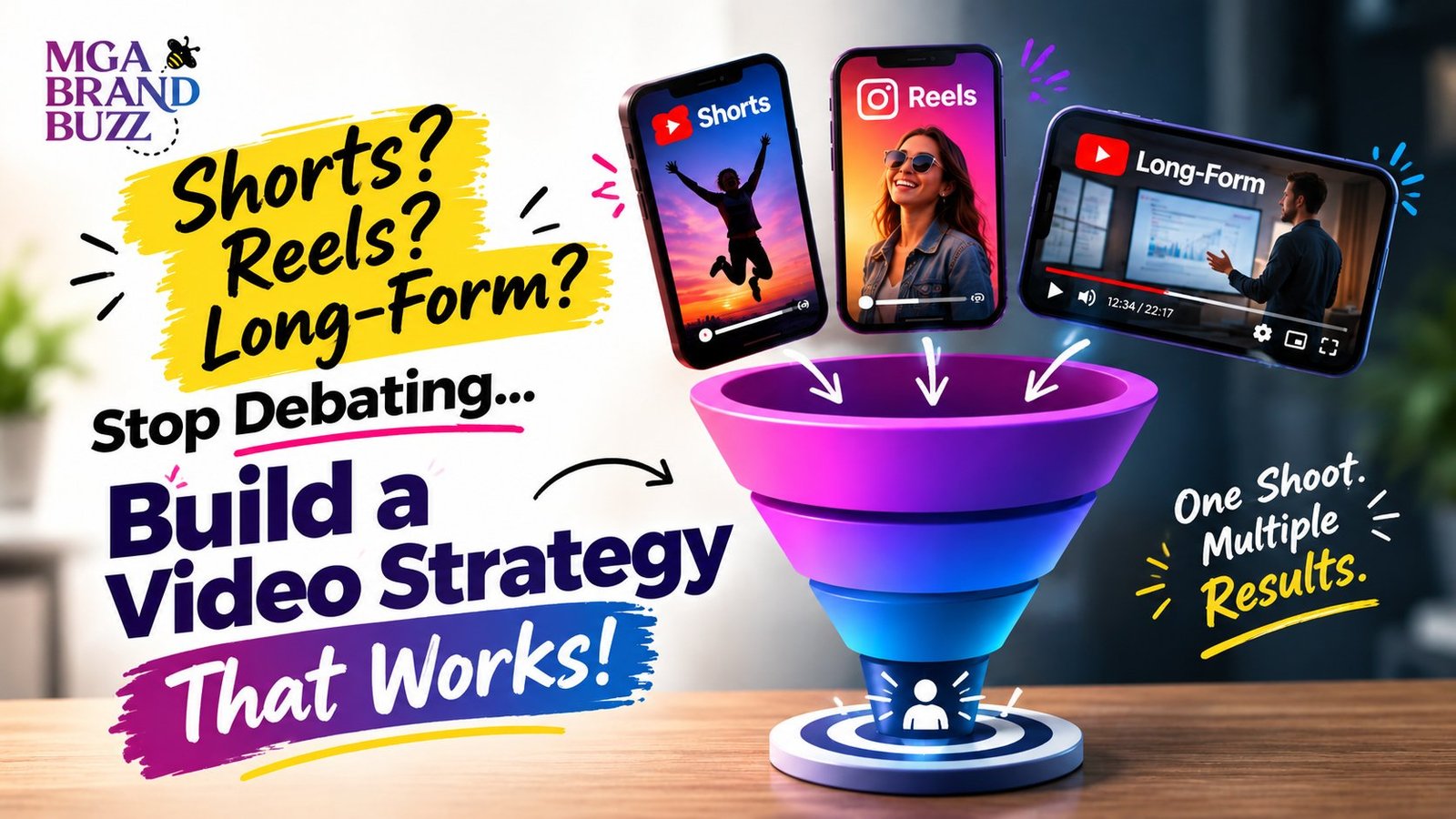
Somewhere in your content calendar right now, there's an argument nobody's actually having out loud: should this be a Short, a Reel, or a proper long-form video? Most businesses just default to whatever's trending, borrow whatever worked on someone else's post, and hope for the best, the same guesswork we've broken down in our platform breakdown before.
The businesses winning at video in 2026 stopped picking a favorite format. They started picking the right format for the job, every single time.
This isn't another "Shorts are eating the internet" hot take. It's a practical framework for deciding when short-form wins, when long-form still beats it outright, and how to stop wasting production time on the wrong format for the wrong goal.
The Real Question Isn't Which Format Wins, It's Which Job Each One Does
Treating "video strategy" as a single decision, pick Shorts or pick long-form, is the mistake that quietly wastes the most budget. Short-form and long-form video aren't competing products. They're different tools solving different problems in your funnel.
A fifteen-second Reel and a twelve-minute YouTube video are almost never trying to accomplish the same thing. One is built to interrupt a scroll and earn a follow. The other is built to answer a real question thoroughly enough that someone trusts you with their money. Comparing them head to head is like comparing a billboard to a sales call.
Where Short-Form Video Actually Wins
Reels and YouTube Shorts consistently outperform long-form for a specific, narrow set of goals.
Cold Audience Discovery
Short-form is still the cheapest way to get in front of people who have never heard of your brand, since the platforms actively push it to new viewers.
Trend and Culture Riding
A trending sound or format gives short-form content a distribution boost long-form simply can't get, since it borrows attention that's already moving.
Quick Proof and Personality
A fast before-and-after, a founder's face, a single sharp opinion, these land in fifteen seconds and don't need a longer format to work.
Volume Without Burnout
You can realistically publish several short videos a week. Publishing several genuinely good long-form videos a week is a different budget entirely.
If your current goal is simply "more people need to know we exist," short-form is almost always the more efficient starting point, and it's the same logic behind platform comparison we've written about before.
Where Long-Form Video Still Wins, No Contest
For a different set of goals, long-form isn't just competitive with short-form, it's not close. Trying to replace it with a string of fifteen-second clips actively hurts these outcomes.
- Building deep trust with someone genuinely comparing you against competitors
- Ranking for search intent on YouTube itself, where watch time still matters enormously
- Teaching something complex enough that fifteen seconds simply can't cover it honestly
- Giving an existing customer or warm lead the confidence to finally convert
- Repurposing into blog content, email sequences, and clips, since a long-form video is genuinely raw material for everything else
YouTube Shorts vs Instagram Reels: A Quick, Honest Distinction
These two get treated as interchangeable constantly, and that's a real mistake.
YouTube Shorts Lean Toward Search and Curiosity
Because Shorts live inside YouTube's search-heavy ecosystem, curiosity-driven titles and "part of a series" content tend to perform better, since a viewer might click through to your full channel next.
Reels Lean Toward Culture and Immediacy
Instagram's audience is more feed-native and trend-driven. Reels tied to a current sound, meme, or aesthetic moment tend to spread faster there than the same content would on YouTube.
Neither platform's own YouTube Creators guidance nor Instagram's business resources pretend these behave identically, and treating them that way is why so many businesses cross-post the exact same clip everywhere and wonder why performance is inconsistent.
A Simple Framework: Match the Format to the Funnel Stage
Instead of debating formats in the abstract, run every video idea through this quick filter before you shoot anything.
Step 1: Name the Actual Goal
Awareness, consideration, or conversion. Not "engagement" in general, an actual specific outcome you can measure afterward.
Step 2: Match the Format to That Goal
Awareness leans short-form. Consideration usually needs a mid-length explainer. Conversion almost always benefits from longer, more thorough proof.
Step 3: Shoot Once, Cut for Multiple Formats
A single well-planned shoot can produce one long-form piece and several short clips from the same footage, instead of treating each format as a separate project.
Step 4: Track the Metric That Matches the Goal
Reach for awareness content, watch time and saves for consideration content, and actual conversions or bookings for the long-form pieces sitting further down the funnel.
Common Mistakes Businesses Make With Video Strategy
- Publishing only short-form and wondering why nobody who watches actually converts
- Publishing only long-form and wondering why nobody new ever finds the channel
- Copying a competitor's format without checking whether it matches their actual goal or just yours
- Judging a short-form clip and a long-form video by the exact same success metric
- Treating every video as a one-off instead of planning shoots that serve multiple formats at once
Most of these come from picking a format out of habit rather than intention, the same trap covered in more depth in our piece on structured testing for social content generally.
What the Platforms Are Actually Rewarding Right Now
Retention is the metric quietly deciding almost everything in 2026, on both short-form and long-form video. A fifteen-second clip that holds attention to the end outperforms a sixty-second one that loses half its viewers by the ten-second mark, and the same principle scales up to a twelve-minute video.
Industry research from sources like Think with Google consistently points to the same pattern: platforms reward whichever format actually keeps someone watching, not whichever format is simply shorter or trendier on paper.
A Quick Checklist for Long-Form Video That Actually Ranks
Long-form video carries extra weight because it can rank in both YouTube and Google search results at once, but only if it's built with that in mind from the start.
- A title that matches how someone would actually type or say the question, not a clever pun that hides the topic
- The core answer or payoff addressed within the first thirty seconds, so viewers and the algorithm both see the video deliver quickly
- Chapters or timestamps for anything over five minutes, making the video easier to navigate and more likely to be featured in search results
- A description that genuinely summarizes the content, not just a wall of hashtags and links
- Captions or subtitles included, since a meaningful share of viewers watch with sound off, especially in shared or public settings
None of this is complicated, but skipping it is exactly why two videos with identical production quality can perform completely differently once they're live.
How to Repurpose One Shoot Into an Entire Week of Content
The most efficient video strategies in 2026 don't treat short-form and long-form as separate projects. A single, well-planned shoot for one long-form video, a product walkthrough, an interview, a behind-the-scenes day, can realistically produce four or five short clips as a byproduct, each one built around its own strongest fifteen-second moment.
This single habit is often the actual difference between a business that "does video" occasionally and one that consistently shows up everywhere without multiplying its shoot days. A well-designed landing page still matters here too, since even the best video sends traffic somewhere, and a landing page that can't convert that traffic wastes the entire effort behind the video.
Small Business vs Larger Brand: Different Right Answers
A larger brand with an existing audience can often lean harder into long-form, since people already trust them enough to sit through it. A smaller or newer business usually needs to earn that attention first through short-form, then graduate warmed-up viewers into longer content once curiosity is established.
Neither path is more "correct." They're solving for different starting points. Benchmarks from firms like industry benchmarks consistently show smaller accounts getting disproportionate reach from short-form specifically because it's the format platforms use to introduce new creators to new audiences.
If you're a small business skipping long-form entirely because it feels intimidating, that's usually a production and planning gap, not a strategy problem, and it's exactly the kind of gap a SEO-aware content plan can help close, since long-form video is one of the few content types that ranks on both YouTube and Google search simultaneously.
A Realistic Example of the Framework in Action
Picture a home services business, say a small interior design studio, deciding what to shoot this month. Under the old "pick a format" mindset, they'd film a single polished walkthrough video and post it once, hoping it does everything at once: introduce the brand, explain the process, and convince someone to book a consultation.
Under the framework above, that same shoot gets planned differently from the start. The full walkthrough becomes one long-form YouTube video, detailed enough to genuinely help someone compare this studio against others. From the same footage, the editor pulls four short clips: a fifteen-second before-and-after reveal, a quick tip about lighting, a founder reaction moment, and a client testimonial snippet. Each short clip gets posted separately across the week, each one doing its own specific job of pulling in new eyes, while the long-form video sits ready for anyone who clicks through once they're actually interested.
Six months of this compounding, rather than six months of single, isolated uploads, is usually the real difference between a business whose video presence feels thin and one that feels like it's genuinely everywhere.
You Don't Need a Big Budget, You Need a Plan
A common excuse for skipping video entirely is assuming it requires expensive equipment or a dedicated production team. In 2026, that's rarely the actual bottleneck. A decent phone camera, consistent lighting, and a clear plan for what each piece of footage will become outperforms expensive gear pointed at an unplanned shoot almost every time.
- A simple shot list written before filming, covering both the long-form angle and the short-form moments you want to pull from it
- Basic, consistent lighting, even natural window light used the same way every time, matters more than camera resolution
- Clean audio, since viewers tolerate rougher visuals far more easily than audio they can't hear clearly
- A simple editing routine repeated every time, rather than reinventing the process for each new shoot
The businesses that treat video as a system rather than a one-off event are the ones who stop feeling like they need a bigger budget, because the actual constraint was never money. It was planning.
How MGA Brand Buzz Can Help
| What You Need | How We Help | Link |
|---|---|---|
| Short-form Reels and Shorts that actually hold attention | Scripting, shooting, and editing built around retention from the first frame | Video Editing |
| A repurposing system instead of one-off shoots | Planning content calendars that turn one shoot into a full week of formats | Social Media Marketing |
| Thumbnails, covers, and visual identity across formats | Consistent, scroll-stopping visuals that make every format recognizably yours | Graphic Design |
| A video strategy that doesn't fit a standard package | Custom planning for businesses with a specific format mix or niche audience | Custom Solutions |
The Bottom Line
Short-form earns you the look. Long-form earns you the decision. The businesses actually winning at video this year aren't the ones who picked a side, they're the ones who stopped treating this as a debate and started treating it as a system, one shoot producing multiple formats, each one doing the specific job it's actually good at.
Take a look at our services to see how video fits into a complete content system, or explore our recent work to see the format mix in action.
Frequently Asked Questions
Should my business focus on YouTube Shorts, Reels, or long-form video?
Most businesses need a mix. Short-form for discovery and awareness, long-form for trust-building and conversion, planned together rather than chosen as an either-or decision.
Is long-form video still worth it in 2026?
Yes, especially for search visibility and converting warm leads. Short-form dominates discovery, but long-form remains far more effective at building the trust needed to actually convert a viewer into a customer.
What's the real difference between YouTube Shorts and Instagram Reels?
Shorts lean toward search and curiosity-driven content within YouTube's ecosystem, while Reels lean toward culture and trend-driven content native to Instagram's feed. Treating them as identical usually hurts performance on both.
How many short-form videos should a business post per week?
Three to five consistent, well-edited short videos a week generally outperforms daily posting done without a repurposing plan or clear goal behind each piece.
Can one video shoot produce both short-form and long-form content?
Yes, and it's one of the most efficient habits in modern video strategy. A single well-planned shoot can produce one long-form piece plus several short clips built from its strongest moments.
What metric matters most for short-form video?
Retention, specifically how long viewers watch before dropping off, matters more than raw view count, since platforms reward content that holds attention rather than content that's simply seen.
Is short-form video cheaper to produce than long-form?
Usually, but the bigger efficiency gain comes from producing both from the same shoot rather than treating short-form as inherently cheap and long-form as inherently expensive.
If you're ready to stop guessing which format to shoot next and build an actual video strategy around your specific goals, get in touch and we'll help you map it out.